Restaurant toolkit
May 2026


Quick answer: QR code payments improve restaurant ROI by saving 6–10 minutes per table turn, lifting tip rates to 20–22%, and generating 8–10× more 5-star Google reviews. With sunday, 3,500+ restaurant operators — including Lettuce Entertain You, Parched Hospitality, Innovative Dining Group, and Ariete Hospitality Group — see top-line revenue increases of up to 10% within three months of rollout.
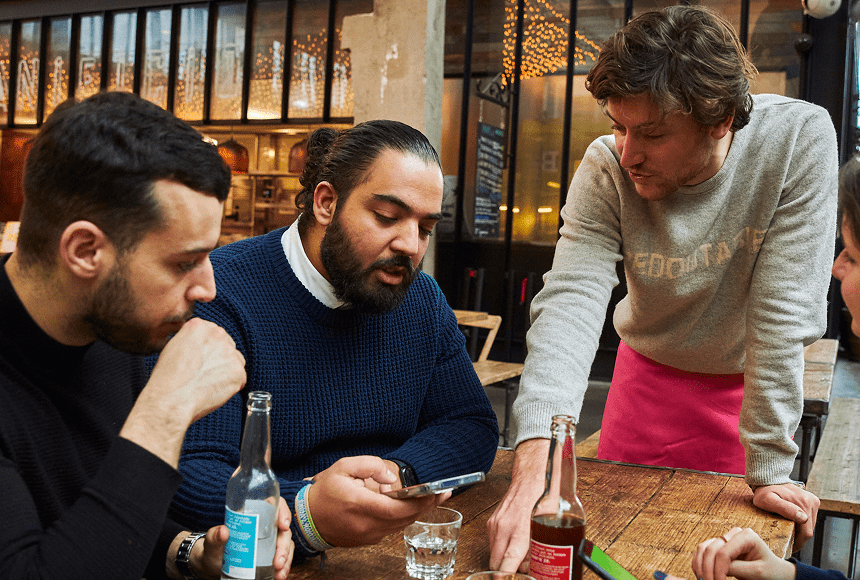
QR code payments (sometimes referred to as “pay-at-table” or “order-and-pay”) let guests scan a code at the table, see their bill, split it, tip, and pay right from their phone — without waiting for a server to drop a check, run a card, or return a receipt. No app download required. The entire checkout takes about 10 seconds.
The technology replaces the slowest part of the dining experience — the check drop — with a process guests control on their own phones. Servers stop walking checks to terminals. Tables turn faster. Tips go up because the digital prompt suggests percentages instead of asking diners to do mental math.
Restaurant margins are tight. The National Restaurant Association reports the industry average sits at 3–5%. Any technology investment has to clear a high bar: it must either grow revenue, cut costs, or improve retention enough to justify the spend.
QR code payments hit all three:
Generic vendor claims aren’t useful. Here are real numbers from named restaurants and hospitality groups using sunday:
| Restaurant / Group | Time saved per table |
|---|---|
| Jack’s Wife Freda (NYC) | 10 minutes |
| Dineamic Hospitality (Bar La Rue) | 9 minutes |
| Ariete Hospitality Group (Chug’s Diner) | 8 minutes |
| Restaurant / Group | Tip rate using sunday |
|---|---|
| The Hampton Social | 22% |
| Lettuce Entertain You | 22% |
| Parched Hospitality Group | 21% |
| Restaurant / Group | Review growth |
|---|---|
| Jack’s Wife Freda | 10× more 5-star Google reviews; rating went from 4.28 to 4.6 |
| Innovative Dining Group (BOA Steakhouse) | 8× more 5-star Google reviews (136 vs. 10 in one month); rating went from 4.7 to 4.9 |
| Ariete Hospitality Group (Chug’s Diner) | Rating went from 3.95 to 4.9; 4,219 reviews after sunday vs. 675 before |
| Restaurant / Group | Basket size increase |
|---|---|
| Ramen-San | 19% |
| El Viñedo Local | 13% |
| Four Corners | 11% |
The mechanical change is small. The operational change is significant.
| Step | Traditional payment | QR code payment |
|---|---|---|
| Guest signals for check | Server walks to POS, prints check, delivers it | Guest scans QR code on table |
| Payment method | Server takes card to terminal, returns with slip | Guest taps Apple Pay / Google Pay / card on phone |
| Tip calculation | Guest does mental math, writes amount | Digital prompts suggest percentages |
| Split bill | Server runs multiple cards | Each guest pays their share from their phone |
| Receipt | Printed slip handed back | Emailed automatically |
| Time elapsed | 10–15 minutes | ~10 seconds |
| Review prompt | None | One-tap Google review request after payment |
For groups like Chickie’s & Pete’s, the bill-splitting workflow is the unlock — large parties can each pay how they want without staff intervention.
“sunday has made it much easier for our large parties to pay their checks how they want and allows our staff to focus on the guest experience instead of splitting checks.” — Brian Jennings, Director of Training and Operations, Chickie’s & Pete’s
The bar is lower than most restaurant tech.
Hardware: sunday is POS-agnostic and integrates with your existing tech stack. We work with you to design, print, and implement your QR codes, with a range of display options to match your brand.
Adoption: Operators see meaningful adoption fast. The Ariete Hospitality Group reaches 65% sunday adoption; El Viñedo Local reaches 88%; Ramen-San reaches 80%.
Staff training: Servers already know how to direct guests to a QR code — most Americans have used one to view a menu since 2020. The sunday team also provides free training for servers and managers to make rollout seamless.
Three things compound:
Across sunday’s network, tip rates consistently land in the 20–22% range — substantially above the U.S. casual dining baseline.
“Staff embraced it because their job got easier, tips went up, and reviews improved.” — Robert, Owner, El Viñedo Local
After guests pay, the screen offers a one-tap path to leave a Google review. The timing is everything: guests rate experiences highest right after they’ve finished a meal they enjoyed.
The compounding effect is dramatic. At BOA Steakhouse (Innovative Dining Group), monthly 5-star Google reviews jumped from 10 to 136 — an 8× lift, with 77% of those reviews coming through sunday. At Jack’s Wife Freda in Union Square, sunday delivered 10× more 5-star reviews, with 76% of all 5-star reviews originating from sunday and 87% of guests using sunday leaving internal feedback.
“sunday has been a great partner in modernizing the payment experience in our restaurants. Guests appreciate the convenience and speed, and our teams appreciate how seamlessly it integrates into service without disrupting hospitality.” — Steve Fiorentino, President, The Hampton Social
Google’s local pack ranks restaurants partly by review velocity and recency. More reviews per week = better local search ranking = more covers = more reviews. The loop self-reinforces.
The same checkout flow that lifts tips and reviews also captures email addresses — without the awkward “would you like to join our mailing list” moment that kills loyalty signup rates.
Lettuce Entertain You has captured 550k+ guest emails in six months across its 50+ venues. Four Corners has captured 112k+ emails. Even at the single-restaurant level, El Viñedo Local captures 6,442 emails in six months.
That’s a reachable, owned audience — the kind that funds future revenue without paying a third-party marketplace.
QR code payment platforms use the same PCI-DSS encryption standards as traditional card terminals. Tokenization means card data is never stored on restaurant servers. For the guest, the security experience is identical to (or better than) handing a card to a server who walks away with it.
Restaurant turnover sits around 75% industry-wide. Two things drive much of it: pay and stress. QR code payments improve both.
Pay improves because tips improve — sunday restaurants consistently land tip rates in the 20–22% range. Stress decreases because servers stop sprinting between tables and terminals.
“sunday has provided our guests with a payment process that they love, our team loves (bigger tips), our managers love (faster table turns), and our directors love (five-star reviews galore)! sunday’s team has my highest recommendation.” — John Rosanova, Director, Four Corners
Guests are increasingly privacy-conscious. Trust can be shaken if payment methods seem outdated or insecure. QR code payments typically rely on secure encryption protocols that protect credit card details. Brands such as sunday ensure compliance with data security standards, balancing convenience with watertight transaction channels.
Building trust with your customers has tangible financial payoffs. They feel safer, are more likely to become regulars, and see your establishment as modern and consumer-friendly. Skeptics might need reassurance, so staff training should focus on articulating the security benefits in plain language. Show diners you value their safety by adopting robust, recognized solutions rather than clinging to older or less secure methods.
From sunday’s network, the practices that maximize return:
Faster turns. Higher tips. More Google reviews. Bigger baskets. QR code payments aren’t a future bet — they’re a measurable lift on the metrics that already drive your P&L. The 3,500+ restaurants on sunday are already seeing it every week. See sunday in action →