

How Google reviews affect your restaurant’s revenue
- March 2026
- Last Update 16 November 2026

Why Google reviews matter for restaurants
When someone’s deciding where to eat, Google is usually their first stop. A search for “Italian restaurant near me” doesn’t just give you names but a star rating and review count for each one.
That snapshot shapes decisions in seconds. Guests use it to filter options before they’ve even clicked through to your website or menu. A higher Google rating doesn’t just look better. It gets your restaurant seen and chosen more often.
That matters whether you’re trying to attract new guests or simply hold your ground against nearby competition.
The numbers: how your Google rating converts into more covers
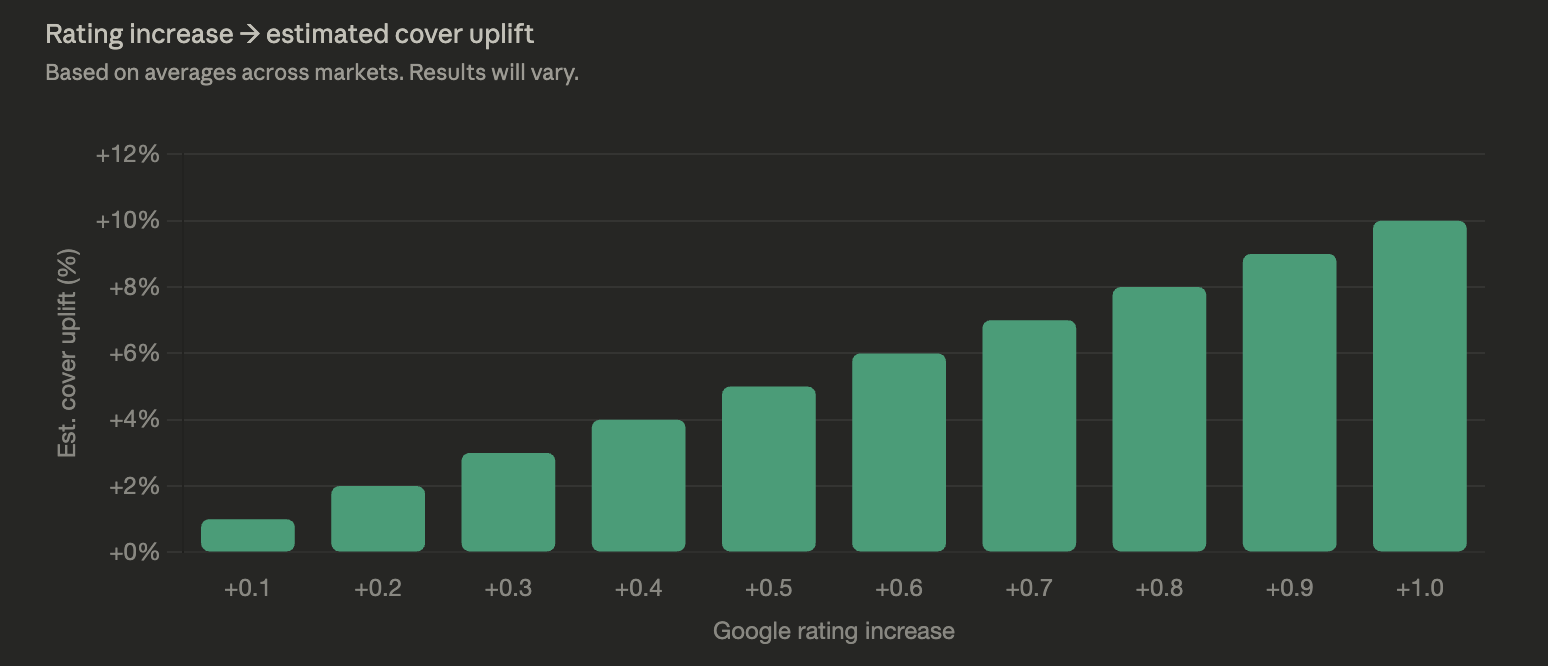
Data from external studies and sunday’s own restaurant base points to a consistent relationship between Google ratings and cover volume:
- +0.1 star rating ≈ +1% more covers
- +1.0 star rating ≈ +10% more covers (slightly more, on average)
These are averages across a range of restaurants and markets not guarantees. But the pattern holds steadily across different rating brackets.
Example 1: A 150-cover restaurant running 5 services a week improves its Google rating from 4.2 to 4.5. A +0.3 increase turning into +3% more covers, or around 4–5 additional guests per service on average.
Example 2: A restaurant at 3.9 stars climbs to 4.4. A +0.5 increase gets you +5% more covers. At 700 weekly covers, that’s 35 more guests per week without changing a single thing about the menu or marketing.
Small increments compound. And consistently getting new Google reviews, it isn’t just about reputation management, it’s a long-term acquisition channel.
Why your Google rating has this impact on foot traffic
Two forces are at work: search visibility and social proof.
Google Maps ranking and local search visibility
Google’s local ranking algorithm has shifted significantly. It now weighs the volume and recency of reviews heavily. And it pays most attention to ones from the past 14 days. A restaurant with 50 recent Google reviews can outrank one with 2,000 older ones. Freshness of signals matters more than accumulated history.
Google’s AI (Gemini) also reads review content, not just star counts. If guests repeatedly mention a specific dish, experience, or quality, Google indexes your restaurant as a destination for that thing. You stop being a generic “American restaurant” and become the place known for a specific product — and you get surfaced in relevant local searches accordingly.
Google Maps also now offers curated lists — Trending, Local Gems, Foodie Top picks — based on recent engagement signals. Appearing on one of those lists is a direct traffic driver.
Social proof and click-through rates
The second factor is simpler: guests trust other guests. A 4.6-star restaurant with 400 reviews signals something different to a first-time guest than a 4.6-star restaurant with 40 reviews. Volume is part of the credibility. Google ratings also surface prominently in Google Ads and Maps, reinforcing the impression before someone has even decided to click through to your listing.
How top-rated restaurants get more Google reviews, and where sunday fits
The restaurants that consistently grow their Google ratings aren’t asking guests to leave reviews as they’re walking out the door. They’re making it frictionless at exactly the right moment.
The right moment is when the guest is still at the table. That’s when the intent to leave a review is highest and when it’s most likely to actually happen.
Most restaurants lose this window. By the time a guest gets home, the impulse is gone.
What high-performing venues do to increase Google reviews:
- Prompt guests at the point of payment, when satisfaction is most immediate
- Make it one step, not three. A direct link to the Google review page, not a homepage
- Collect reviews consistently, not in bursts
- Encourage specific feedback so reviews mention dishes, experiences, and qualities that improve how Google categorises and surfaces the venue
sunday’s payment flow prompts guests to leave a Google review as part of the checkout experience. Guests pay, rate their experience, and are directed to Google. All without the server asking or a follow up email.
The result is a steady, high-volume stream of fresh reviews that give the Google algorithm what it wants.
5 actionable tips to improve your restaurant's Google rating
These habits drive consistent results:
- Ask at the right moment. Right after payment, while the guest is still happy. Not via email three days later.
- Make it one step. A QR code or direct link to Google. Fewer taps = more reviews.
- Be consistent, not reactive. Chasing reviews after a bad week doesn’t help. A steady stream of fresh reviews does.
- Respond to every review. Especially negative ones. Guests and Google both pay attention to how you engage — and responses signal that your business is active.
- Encourage specifics. If your team mentions a dish guests loved, they’re more likely to name it in a review — and that specificity helps Google index your restaurant for it.

Even a 0.2 improvement in your Google rating — something achievable in a few months of consistent review collection — can translate into meaningful cover growth. That’s a result most paid marketing channels can’t match at the same cost.
Ready to improve your Google rating?
If you want to understand how sunday can help your restaurant capture more Google reviews systematically, speak to the team.

